

Migrating SAP BW in months, not years: meet WavePath
SAP BW 7.5 leaves mainstream maintenance at the end of 2027, and extended maintenance stops at the end of 2030 (SAP’s maintenance strategy). For most SAP customers the question is no longer whether to leave BW, but how quickly they can do it without breaking the business.
The destination is rarely the hard part. SAP Datasphere and Business Data Cloud, Databricks, Snowflake and Microsoft Fabric are all mature platforms. What stalls programmes is the journey: hundreds of dataflows, twenty years of custom logic, and a rebuild that is still largely done by hand.
That is why we built WavePath, an AI-powered accelerator that reads your BW system and turns it into a migration plan and working code for the platform you choose. In this post we explain what it does, how it works and what it changes for your programme.
Why BW migrations stall
Most BW systems were built ten to twenty years ago and have grown model by model ever since. A typical estate holds hundreds or thousands of InfoProviders, transformations and queries, tied together by dependencies nobody has fully documented. Three things turn that into a multi-year programme.
-
- The assessment takes months. Before a single object moves, someone has to work out what exists, what feeds what and what is still used. That is usually done by hand, in spreadsheets that are out of date by the time they are finished.
-
- Business logic hides in ABAP. Start, end and expert routines carry rules that must be rewritten for the target platform. Effort tracks closely with how much of that code there is, and it rarely shows up in the first estimate.
-
- Everything gets migrated, including what nobody uses. Without usage data, dormant cubes and forgotten reports are rebuilt alongside the models the business actually depends on.
The result is familiar: programmes that run for years, cost millions in engineering effort and lose momentum before a single business user sees the benefit.
Meet WavePath
WavePath is an AI-powered migration agent that analyses your SAP BW system, understands every dataflow and recreates it on a modern cloud platform. It turns the slowest, most manual parts of a BW migration into a repeatable, largely automated process.
It is built by people who have spent their careers inside BW. The tool captures what our consultants learned on real migrations: the patterns that convert cleanly, the ones that never do, and the questions a steering group always asks.
WavePath supports four destinations: SAP Datasphere (including SAP Business Data Cloud), Snowflake, Databricks and Microsoft Fabric. One analysis serves all of them, so your platform choice can follow the facts instead of the other way round.
WavePath is not a black box. Everything it produces is readable SQL or native platform definitions, with a clear list of what still needs a consultant’s judgement. You stay in control of what goes live.
How WavePath works
WavePath takes every system through the same six steps, from raw BW metadata to deployed objects on your target platform.
-
- Read the metadata. WavePath works from metadata exports of your BW system, such as the BW Metadata Extractor or Bluetelligence DataLineage. It picks up every object, transformation rule, field-level lineage and line of ABAP or SQLScript, without touching the source system.
-
- Find out what is actually used. Query statistics show which InfoProviders and reports the business still runs. Unused objects become decommissioning candidates, and retired source systems drop out of scope together with everything fed only by them.
-
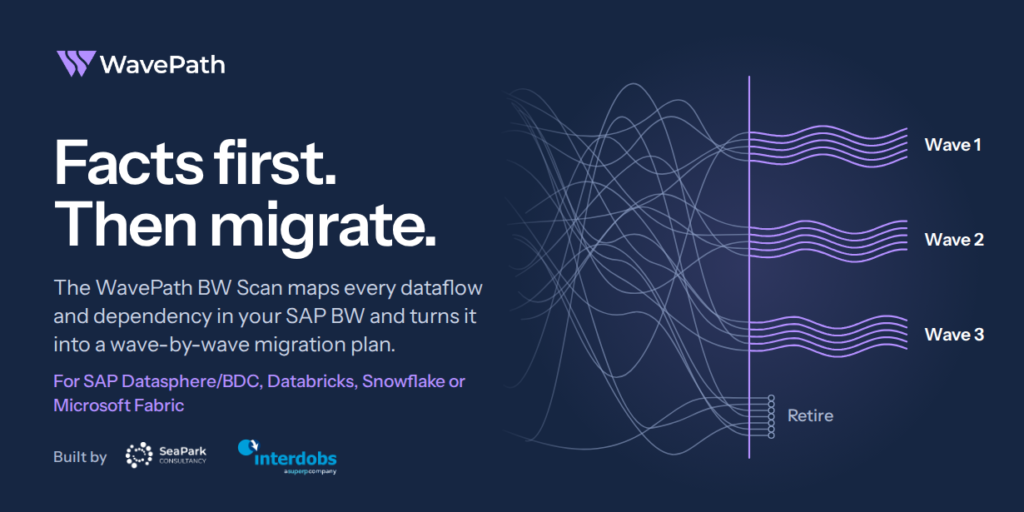
- Plan in waves. WavePath builds the full dependency graph and orders objects into migration waves. Each object gets a complexity rating, a convertibility rating and an effort estimate. Shared master data such as material or profit centre is planned once as a common foundation, not counted again for every model that uses it.
-
- Check for SAP standard content. Each BW DataSource is mapped to the matching SAP data product where one exists. That shows where a standard data product in SAP Business Data Cloud can replace a custom flow instead of migrating it.
-
- Convert the logic. WavePath generates tables, views and transformation logic in each target’s own language: CSN for Datasphere, T-SQL for Fabric, and native SQL for Snowflake and Databricks Unity Catalog. ABAP routines with known patterns, such as conditions, filters, string handling and master-data lookups, are translated to SQL. Anything it cannot translate reliably arrives as a clearly marked manual item, never as a silent guess.
-
- Review, optimise and deploy. Consultants refine the generated code in a dedicated workspace, with the original ABAP, metadata and lineage side by side. WavePath then deploys wave by wave, with a dry-run preview first and safeguards that stop reviewed objects from being overwritten.
Throughout, a built-in AI migration assistant answers questions about your system in plain language. Ask which transformations are hardest to convert, what feeds a specific DataStore object or what wave 1 contains. Once you confirm, it can deploy that wave to your target platform.
What it means for your programme
WavePath turns a BW migration from a multi-year risk into a planned, measurable programme. It is built to deliver four results.
| Result | What it means for you |
|---|---|
| Faster migration insights | A fact-based assessment and wave plan of your whole BW estate, instead of months of manual inventory |
| Faster delivery | Hundreds of models converted and deployed by an engine, not rebuilt one by one |
| Less manual engineering | Consultants spend their time on logic that needs judgement, not on rewriting simple mappings |
| Architecture compliance | Every generated model follows your reference architecture and naming conventions, with no drift between teams |
A business case your board can trust. WavePath gives a steering group the facts it needs: how big the estate is, how hard it is, what has to change and in what order. Every figure traces back to your own system metadata, delivered as an interactive dashboard, an Excel report and a management presentation.
Freedom of platform. Because the analysis is platform-neutral, you can compare targets on the same facts. Many organisations end up with a mix, such as Datasphere for SAP-centric reporting next to Databricks or Fabric for the wider data estate.
Value beyond the migration. The same engine generates new data models from a plain-language description in minutes, and checks every model against your architecture standards. That keeps the new platform as clean in year three as it was on go-live.
Ready to leave BW behind?
The fastest way to see what WavePath can do is to point it at your own system. You get the facts on your estate: what is used, what is hard to convert, and a wave plan for the platform you have in mind.
Contact us to plan a demo!
