
The story at TechEd – SAP really wants to leave your data where it is
Update, 30 October 2026. We published the first version of this piece on Tuesday, day one of SAP TechEd in Berlin. Since then we have attended and went through the slide decks of many sessions. The thesis held. Below is the full wrap-up: the answers to the three questions we left open, and what we would do next. One thing is for sure, Dremio is here to stay and is the fundamental piece of the BDC puzzle.
As Prakash Nanduri frames it, “ETL is death”. Ofcourse this is predominantly to spark disccussion, but there is truth in it.
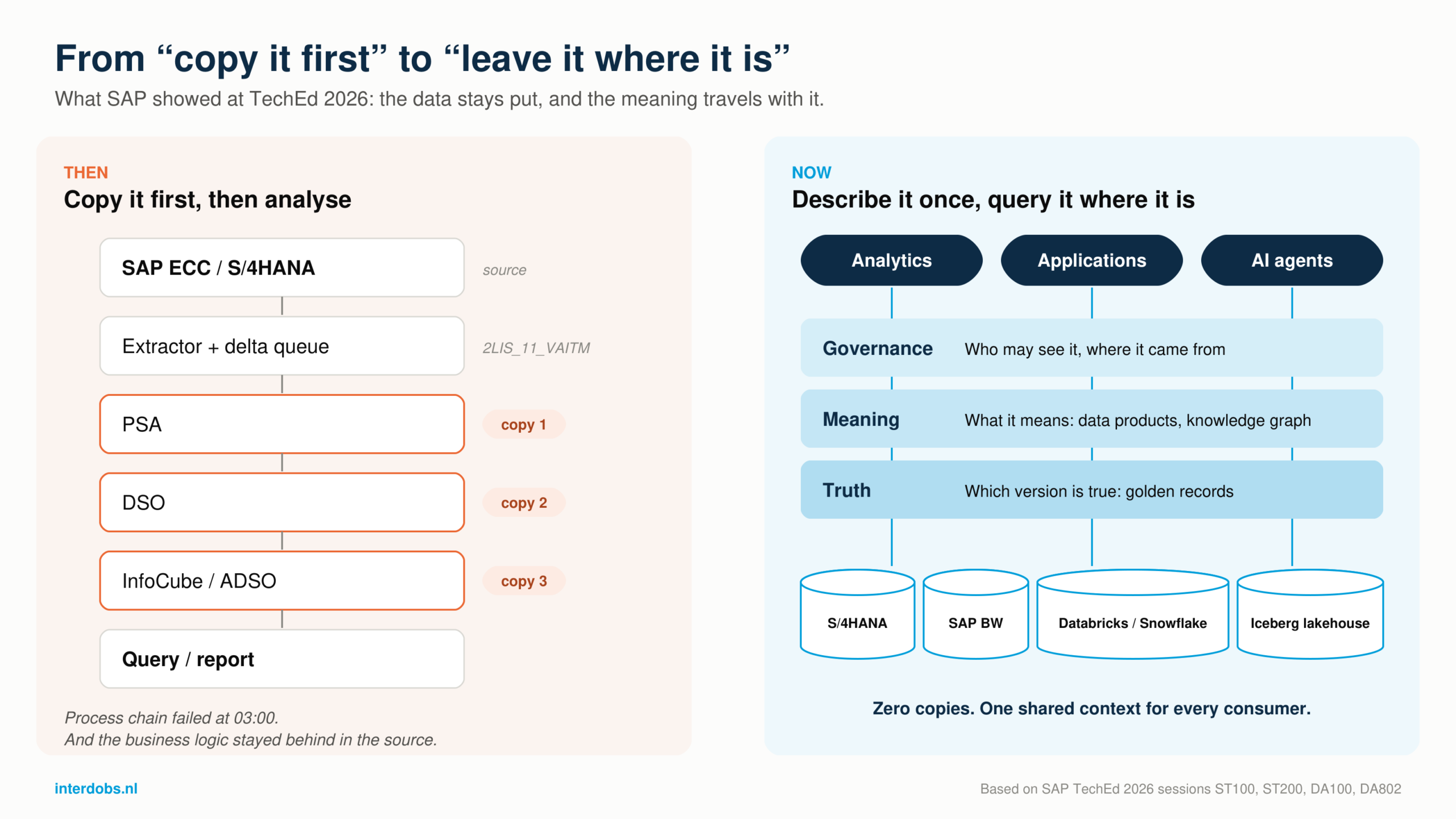
Then and now. Every copy in the old chain lost a bit of business logic; the new stack keeps data in place and shares one context.
Anyone who has built a BW system knows the ritual. Extractors, delta queues, process chains that fail at three in the morning. For as long as most of us can remember, the deal in SAP analytics was simple: if you want to analyse it, copy it first.
SAP TechEd opened in Berlin on Tuesday, its 30th year. The stage belonged to AI agents. But on day one we wrote that the data announcements told a quieter story: SAP wants to stop moving your data around.
Four days and many session decks later, that story is no longer quiet. Almost every TechEd session carried the same picture: open storage at the bottom, a layer of meaning in the middle, agents on top. Ask SAP where data should live now, and the answer was nearly always the same: where it already is.
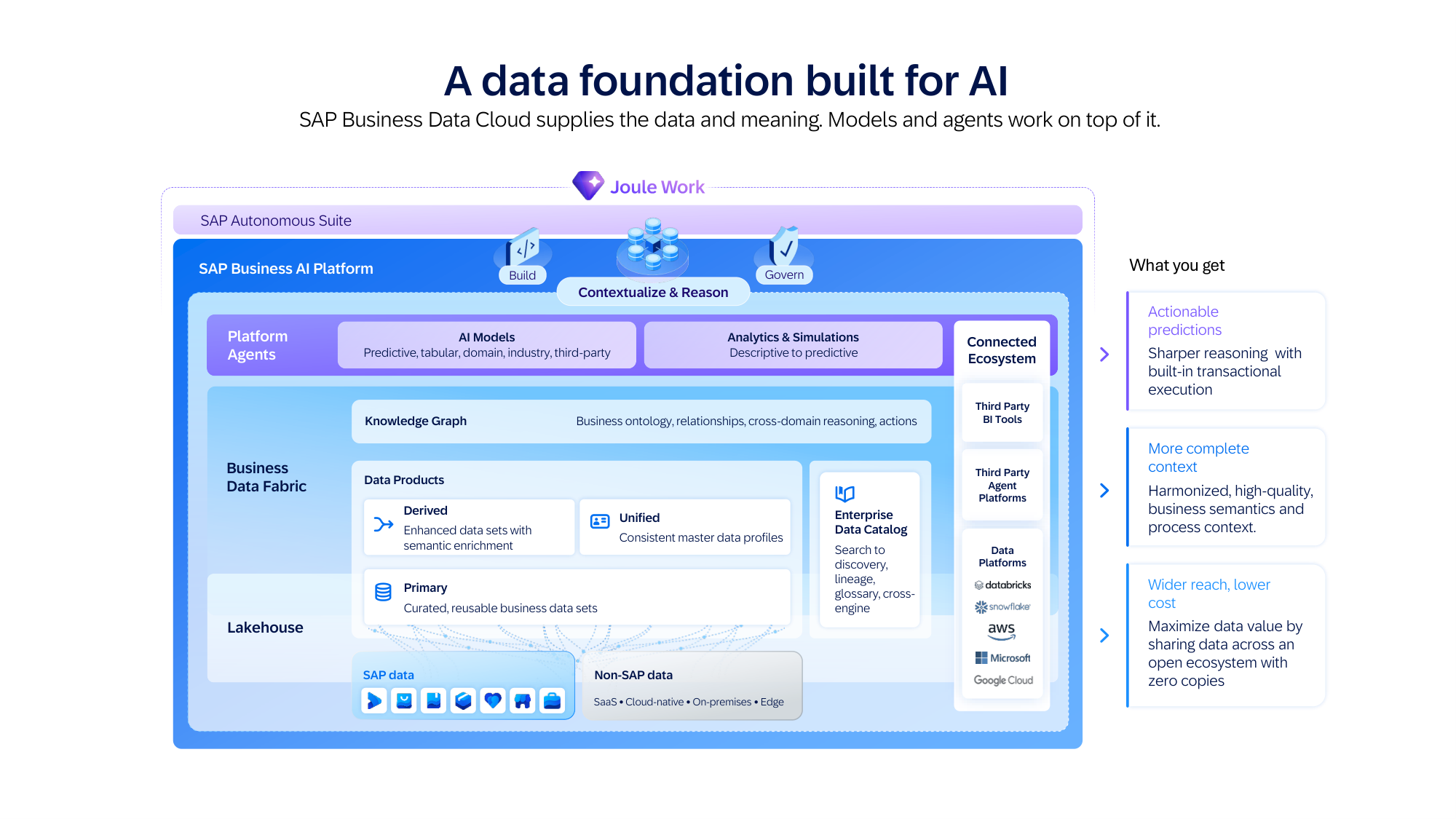
The picture of the week. Some version of this slide appeared in almost every data session: lakehouse at the bottom, knowledge graph in the middle, agents on top. Slide: SAP, session ST100.
A lakehouse, of all things
The vehicle is Dremio, which SAP bought this year. Dremio is a lakehouse: data sits in open files on ordinary storage, and you query it as if it were a warehouse. It is built on Apache Iceberg, the open table format much of the data world has settled on.
After sessions and discussions with Dremio folk, the week filled in the details. Dremio brings its whole open toolkit into Business Data Cloud: Iceberg for tables, Apache Polaris as the catalog, Apache Arrow for fast data transfer, and “Reflections” that speed up queries automatically. The latter is what I would classify as “a sexy piece of data kit”. The plan includes distributed SQL across third-party lakehouses and federated queries into relational databases. SAP has these lakehouse capabilities down for general availability in Q1 2027 (sessions: DA802, ST200).
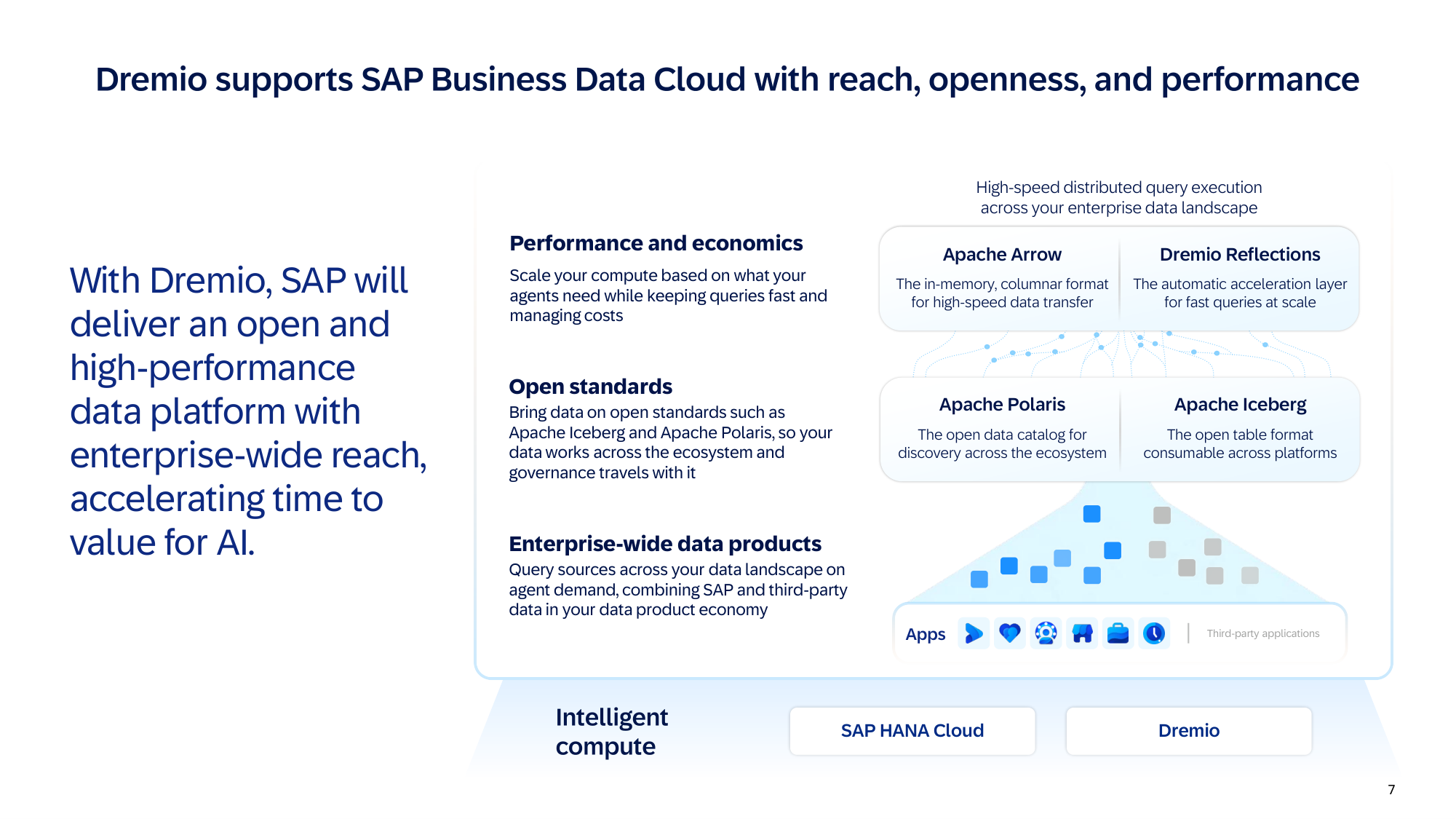
Dremio’s open toolkit inside Business Data Cloud: Iceberg, Polaris, Arrow and Reflections, next to HANA Cloud. Slide: SAP, session ST200.
Sharing is just as open. BDC Connect shares data products with zero copies to platforms such as Databricks and Snowflake, and versions for Microsoft Fabric and Amazon Athena are planned for H1 2027 (DA105). After years of “SAP versus the lakehouse”, SAP’s answer is to buy one and wire itself into everyone else’s.
If that sounds familiar, it should. Around 2010, TechEd introduced HANA with a similar promise: stop pre-aggregating, just compute in memory. This is the same thought one level up. Stop copying, just query. One “slight” problem, it comes with a price. This is were Dremio will make a difference. Talking to executives in the Dremio space, it has become very clear that not only SAP acquired great technology, but also price – performance at a great price. SAP will be competing at price, imagine that.
It is not just a slide, either. ZEISS showed the pattern running in production before Dremio was in the picture (ST107). A real-time HANA Cloud repository is fed from eleven systems, and Datasphere exposes more than 1,500 tables and 1,000 BW assets to cloud consumers without persisting the data. One endpoint instead of a copy per consumer, and a monitoring tool that checks every pipeline for timeliness, completeness and conformance. That last part matters more than it sounds. We’ll come back to it.
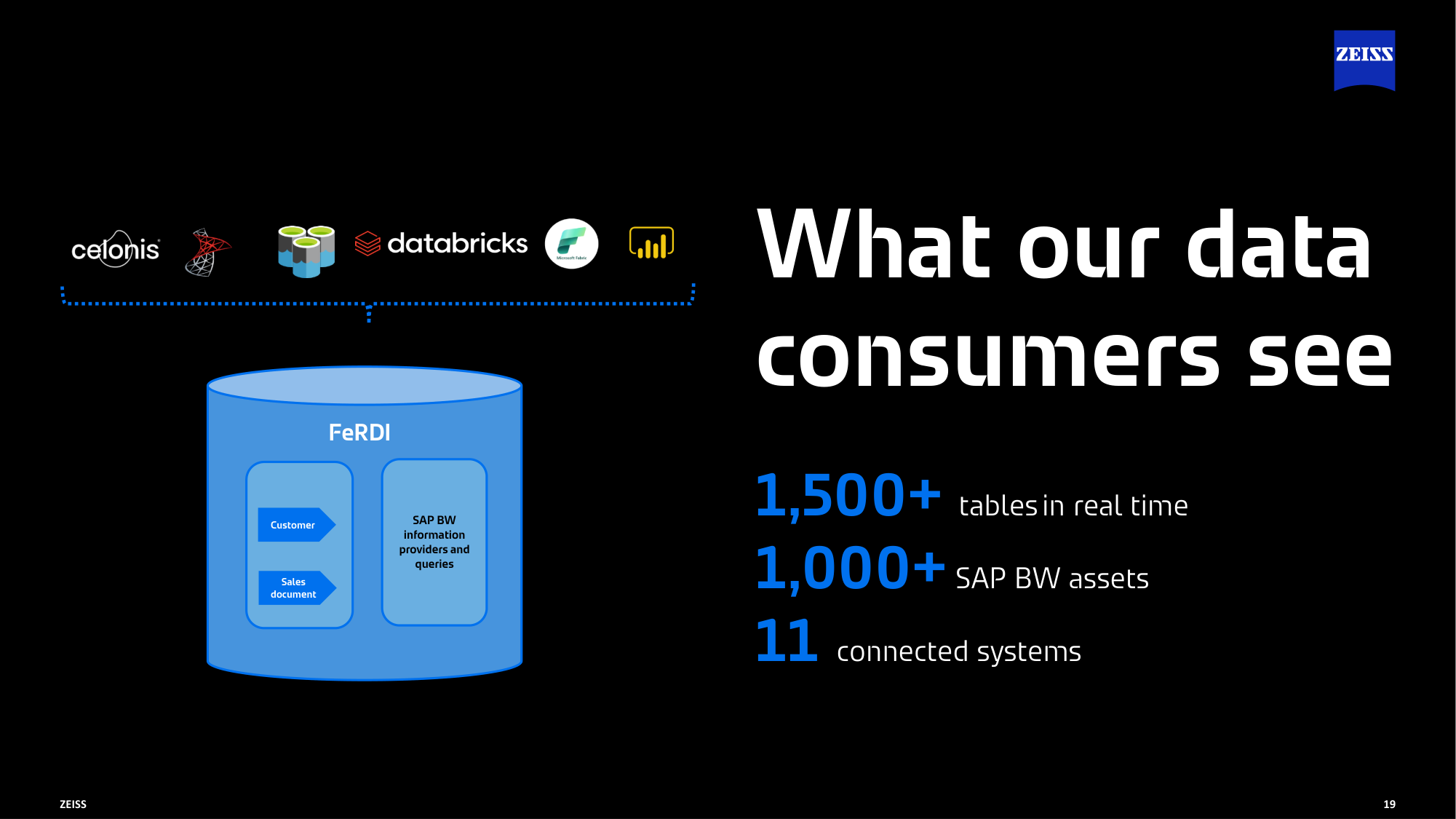
Query in place, in production: ZEISS’ federated real-time data integration. Slide: ZEISS, session ST107.
The hard part was never the storage
Here’s the catch every BW consultant already knows. Moving data was annoying, but it was never the real work. The real work was knowing what the data means.
A sales order in S/4HANA carries decades of SAP logic. Which date counts, which status matters, why that one field is always empty in plant 1000. Copy the table out and all of that stays behind. Leave the data where it is and you still need someone, or something, to explain it.
On Tuesday we wrote that SAP seems to know this. By Friday, SAP was saying it out loud. A session on SAP’s domain models put it better than we did:
In SAP software, this meaning has lived in ABAP code, in documentation, and in the heads of experienced consultants.
SAP TechEd 2026, session RA108
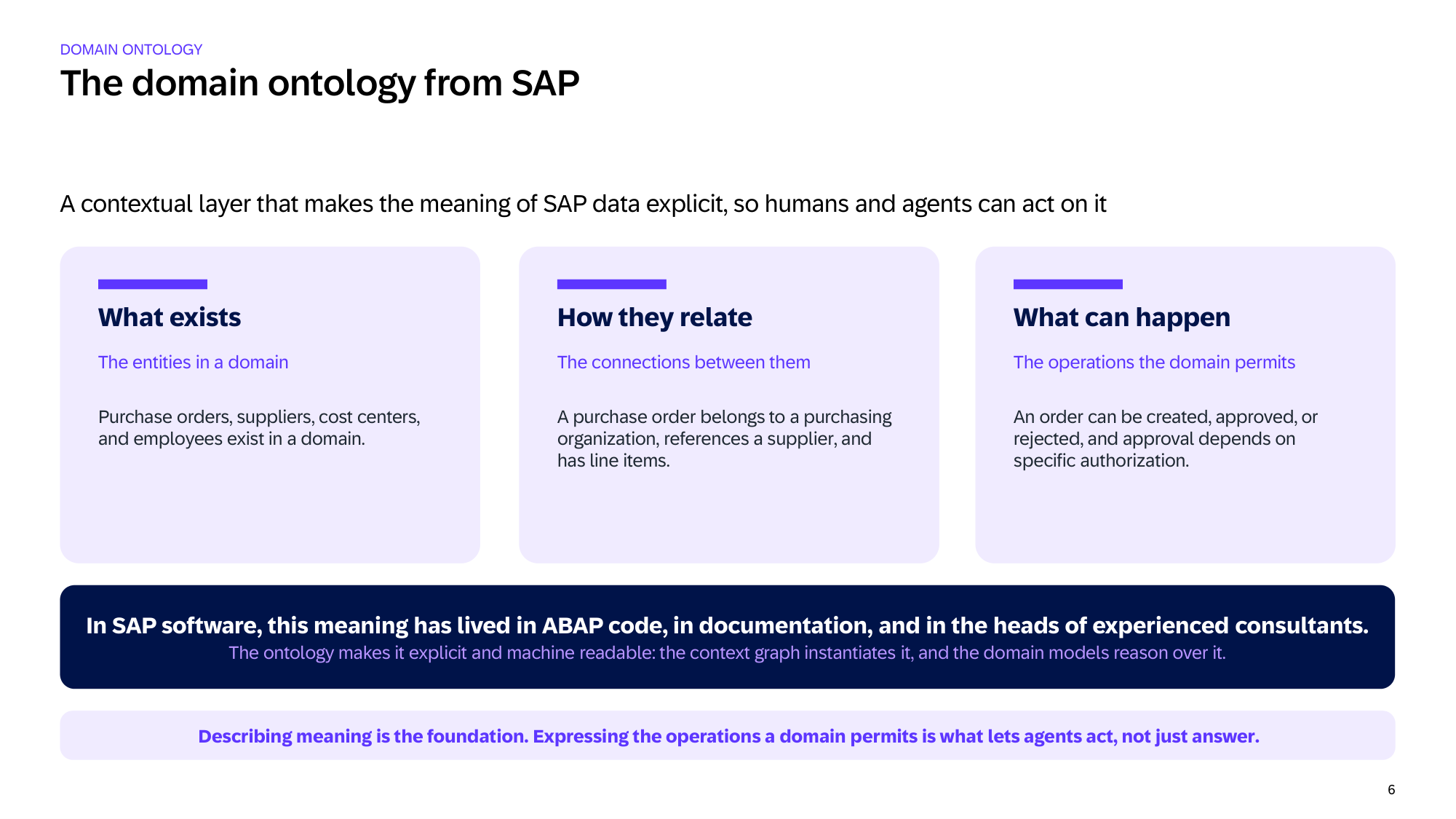
SAP’s three-part definition of meaning: what exists, how it relates, and what may happen. The last part is what lets agents act instead of just answer. Slide: SAP, session RA108.
Another session (DA100) took one ordinary business question and pulled it apart: which customers did we bill the most this quarter, by country group? Behind it sit four questions nobody asks out loud. Which date defines the quarter? What counts as billed? Which data should you use? And what is this user allowed to see? Give the dashboard, the app and the agent each their own copy, and you get three different answers.
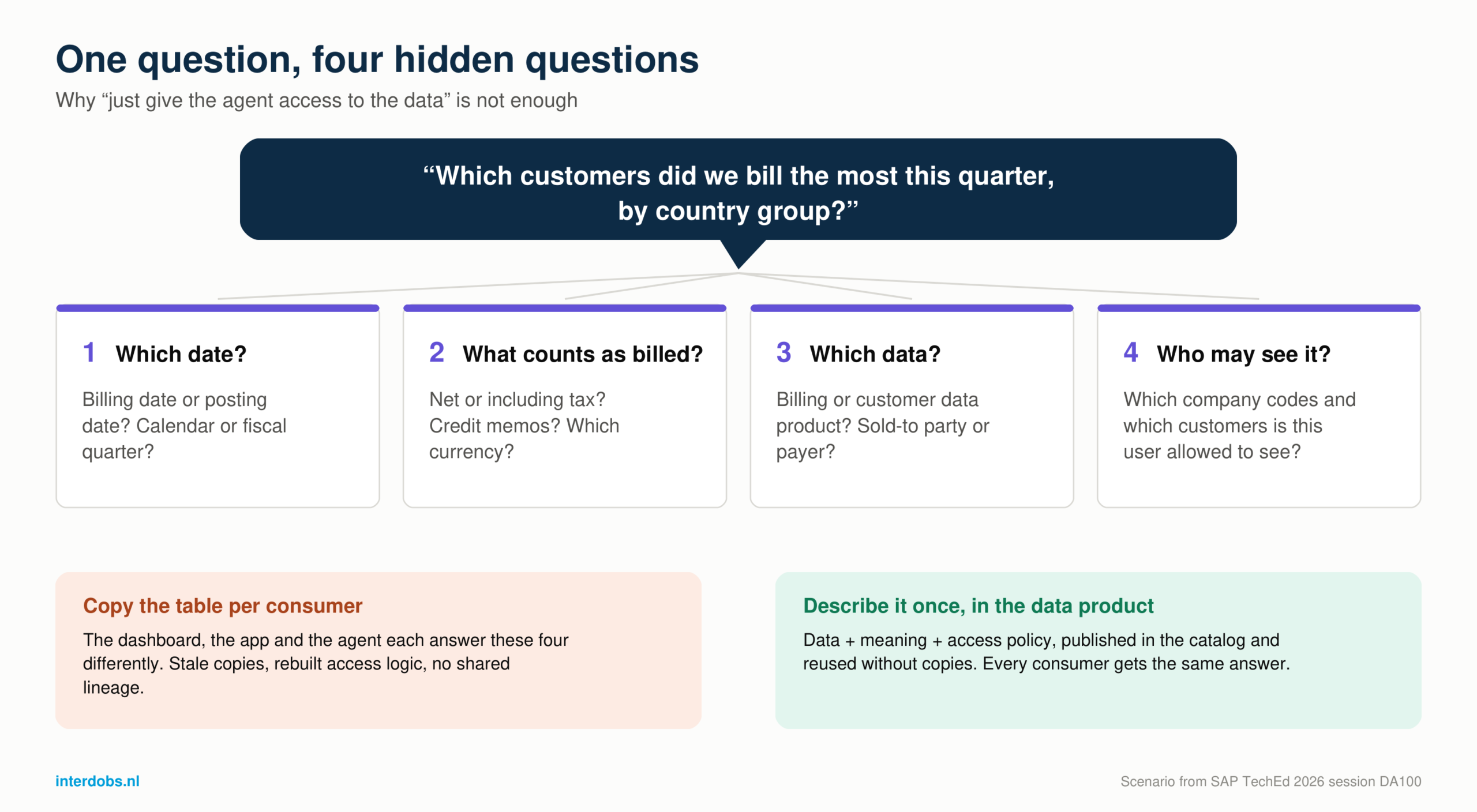
One question, four hidden questions. This is the BW consultant’s everyday work, and now the problem SAP’s AI story depends on.
SAP’s answer is the data product, and it finally has a crisp definition: data, plus meaning, plus an access policy, published once in a catalog and reused without copies. A new Data Product Creation Agent (get used to the acronym “DPCA”) turns a sentence like “combine billing documents and customer data” into a draft in about ten minutes. It looks for existing data products first, then proposes the joins, the grain and the access policy for a human to review. Early adopters get it in Q4 2026, with general availability planned for Q1 2027.
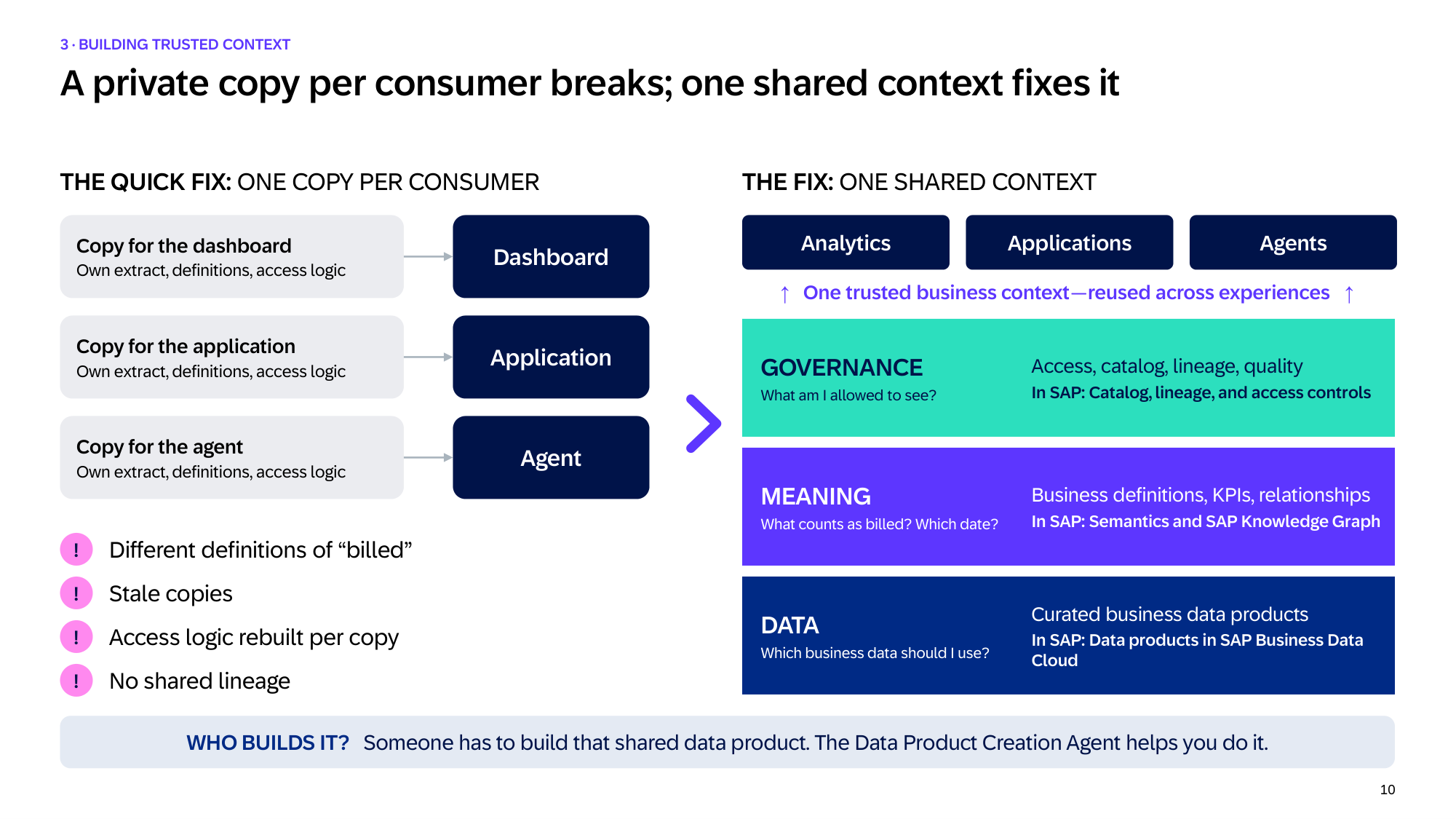
One shared context instead of a copy per consumer. Read the four red bullets on the left and you have described most BW landscapes. Slide: SAP, session DA100.
Underneath sits the part that impressed us most: SAP is turning fifty years of its own logic into a graph. The SAP Knowledge Graph holds more than a billion facts about SAP software, covering 15,000 processes, 260,000 services and 500,000 tables (RA110). For S/4HANA alone, SAP parsed ABAP, CDS, behaviour definitions and documentation into a domain ontology of 19 million nodes and 39 million edges (RA108). SAP says it pays off: by its own figures, grounding Joule Work in the graph raised answer accuracy by 28 to 46 percentage points per line of business, while cutting the cost per query by up to 54%.
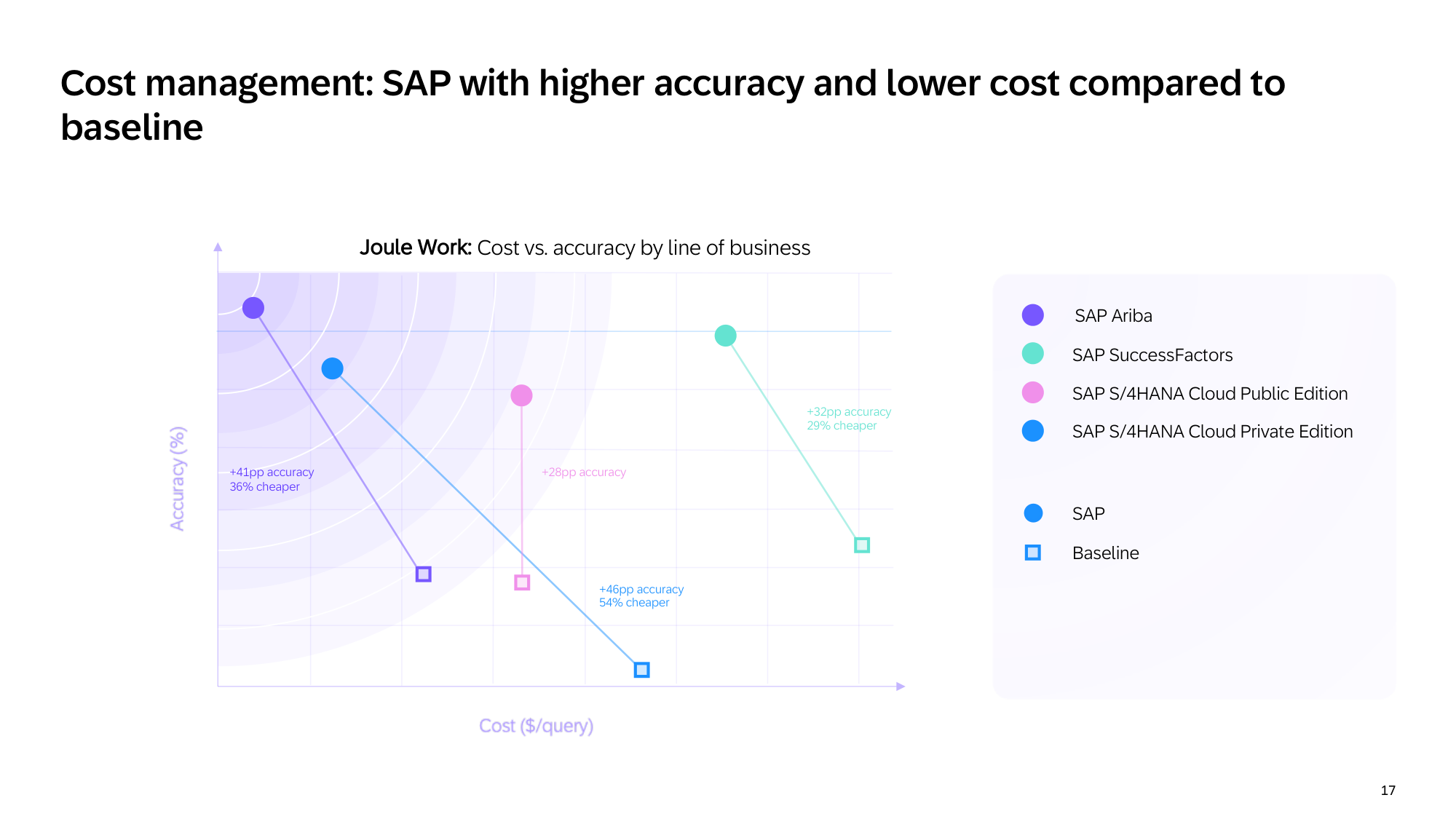
Grounding pays, according to SAP: per line of business, Joule Work with the knowledge graph is both more accurate and cheaper per query than the baseline. Slide: SAP, session RA110.
The Ontology Manager we mentioned on Tuesday lets you build and extend ontologies from SAP and third-party data, and turn what they reveal into workflows or AI model calls. It goes into beta in Q1 2027. Meanwhile, the Knowledge Graph itself is moving from SAP’s reference content towards customer-specific content, down to your own custom fields (RA110). If you want to start sooner, HANA Cloud already ships a knowledge graph engine, with RDF and SPARQL next to SQL and vectors in one database, and metaphactory for visual modelling (ST108). Created by the great teams of Stefan Baeuerle.
Which version is true?
The second question, which version of a record is true, got its own track. The sharpest line of the week came from the master data session:
An autonomous agent doesn’t stop to question whether a vendor record is a duplicate or whether two customer records refer to the same person. It just acts.
SAP TechEd 2026, session DA104
The Dremio and Reltio session put the consequence more bluntly: “confident but wrong decisions at machine speed” (ST200). Bad master data used to produce a wrong report, which someone would question on Monday morning. Now it produces a wrong action.
The division of labour is clear. SAP Master Data Governance stays the quality firewall at the point of creation inside S/4HANA. Reltio, which SAP bought in March, unifies customer, supplier and product records across everything else (ECC, Ariba, third-party systems) and publishes them as unified data products. That is planned for general availability in the second half of 2026.
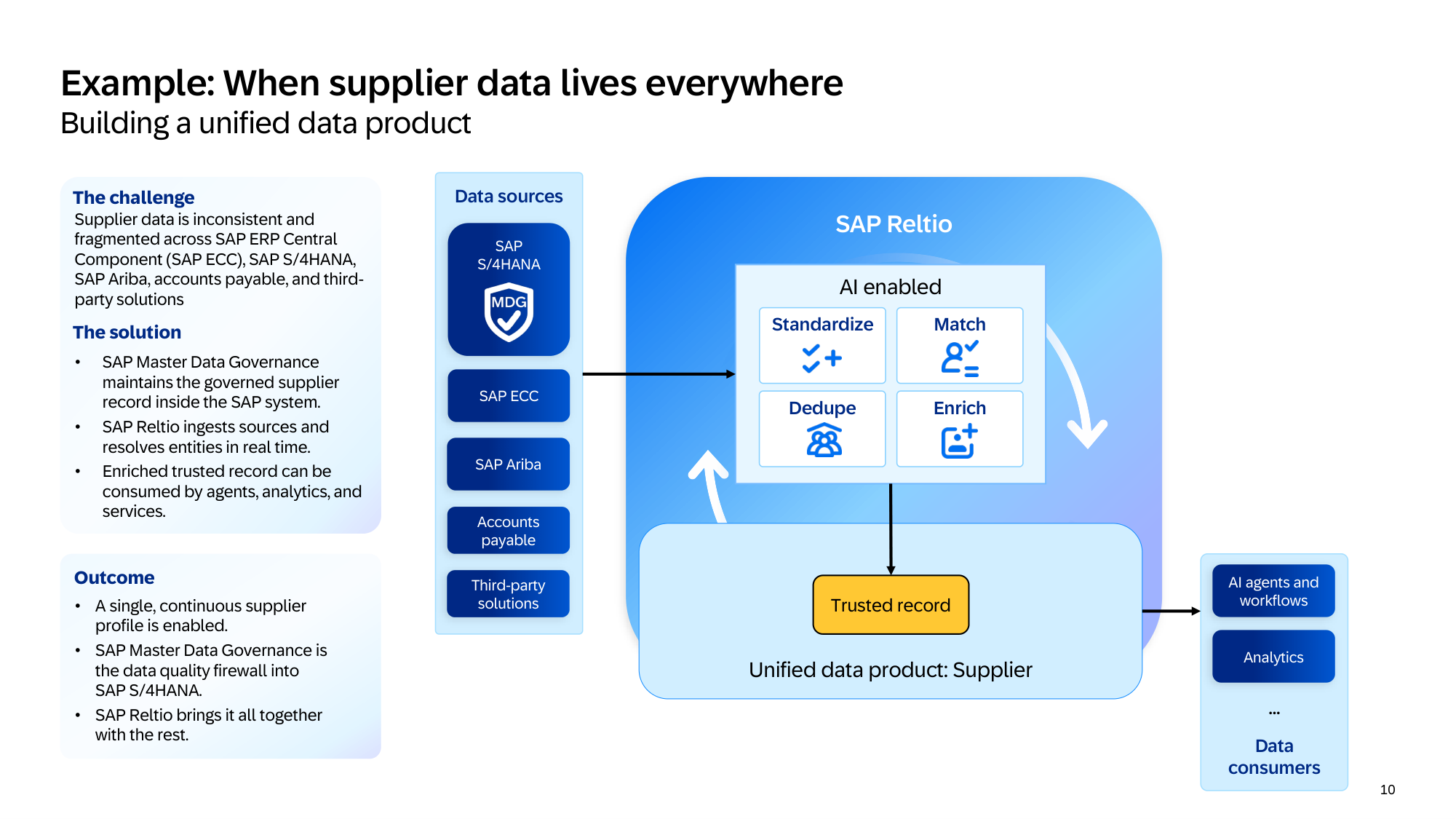
MDG guards the gate, Reltio unifies the rest: one trusted supplier record as a data product. Slide: SAP, session DA104.
The third acquisition got less stage time but deserves a mention. Prior Labs brings TabPFN, a foundation model for tables, alongside SAP’s own SAP-RPT. In HANA Cloud you can already call SAP-RPT straight from SQL to predict values or fill gaps without training a model (DA205). Predictions without a data science project are one more way of not moving data.
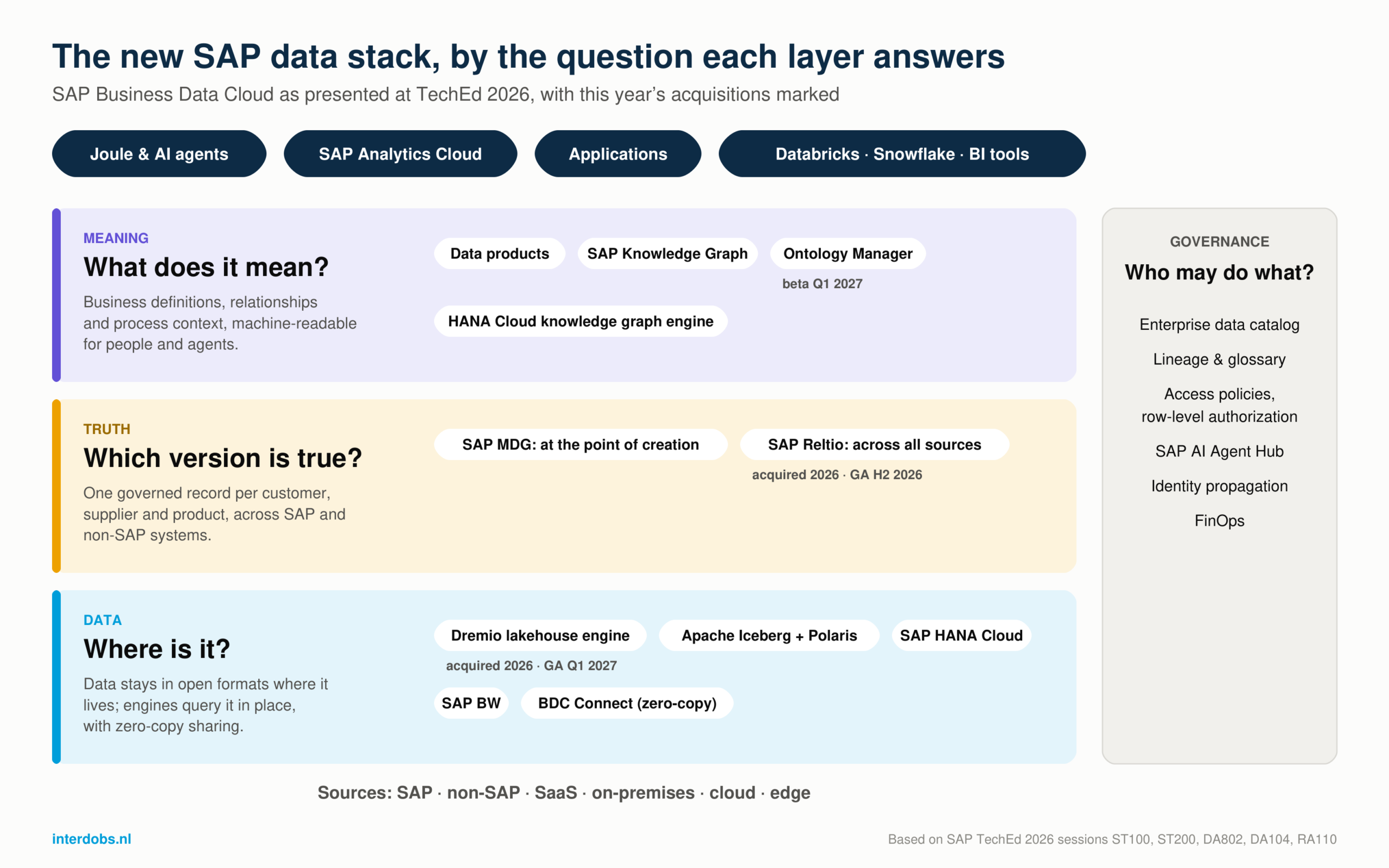
The new stack in one picture: each layer answers one question. Two of the three acquisitions of 2026 sit in it.
The three questions we left open
On Tuesday we ended with three questions: timing, cost, and how today’s Datasphere models fit in. Here is what the week answered, and what it didn’t.
Timing. Most of it lands within six months. Agent memory on HANA Cloud is generally available already. Unified master data with Reltio is planned for H2 2026. The lakehouse and the Ontology Manager beta are planned for Q1 2027. As always with SAP road maps, these are plans, not commitments.
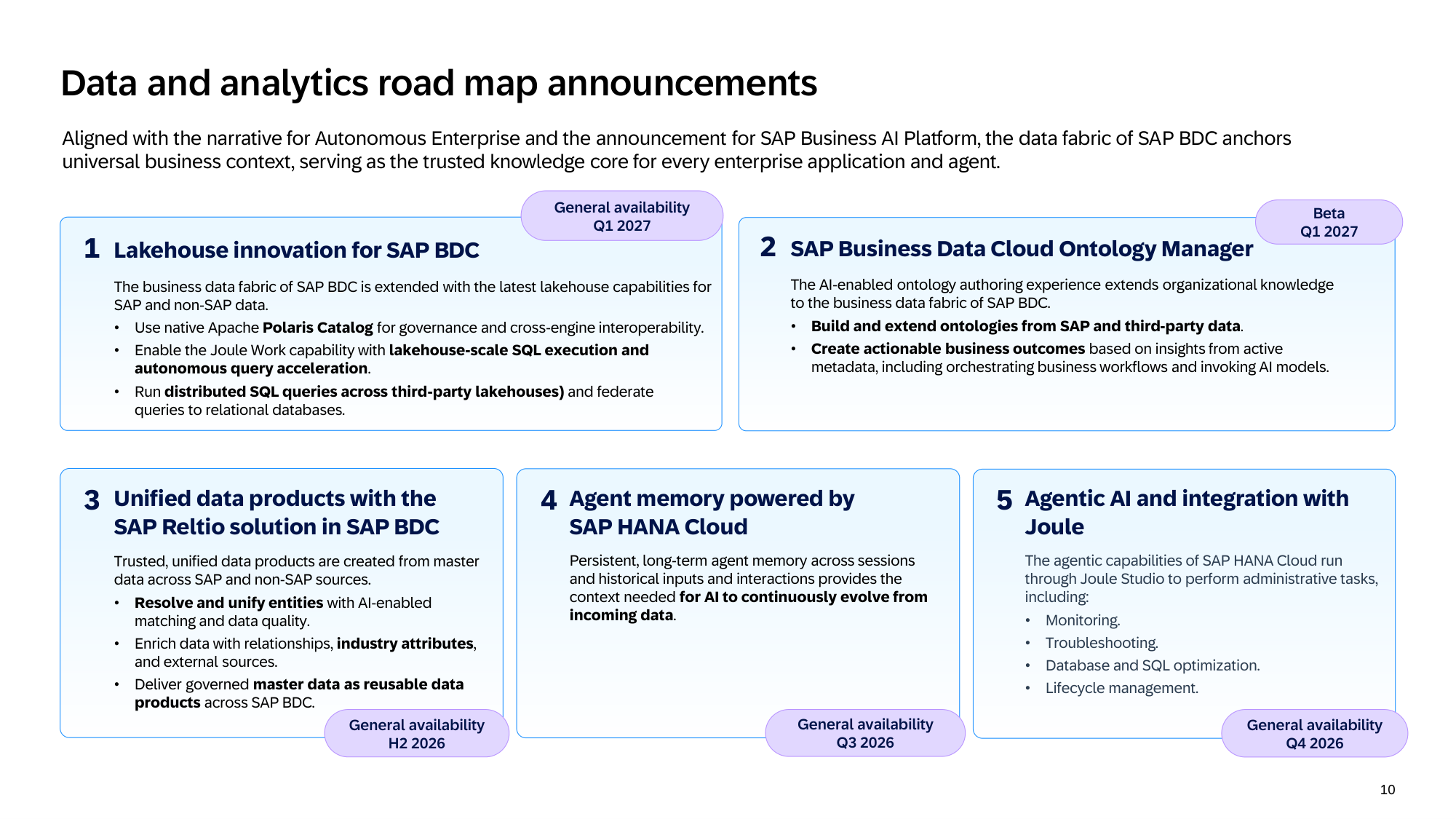
The official version: SAP’s five data announcements with their dates. Slide: SAP, session DA802.
Add SAP’s BW tooling, the data product agent and the new connectors, and the full timeline looks like this:
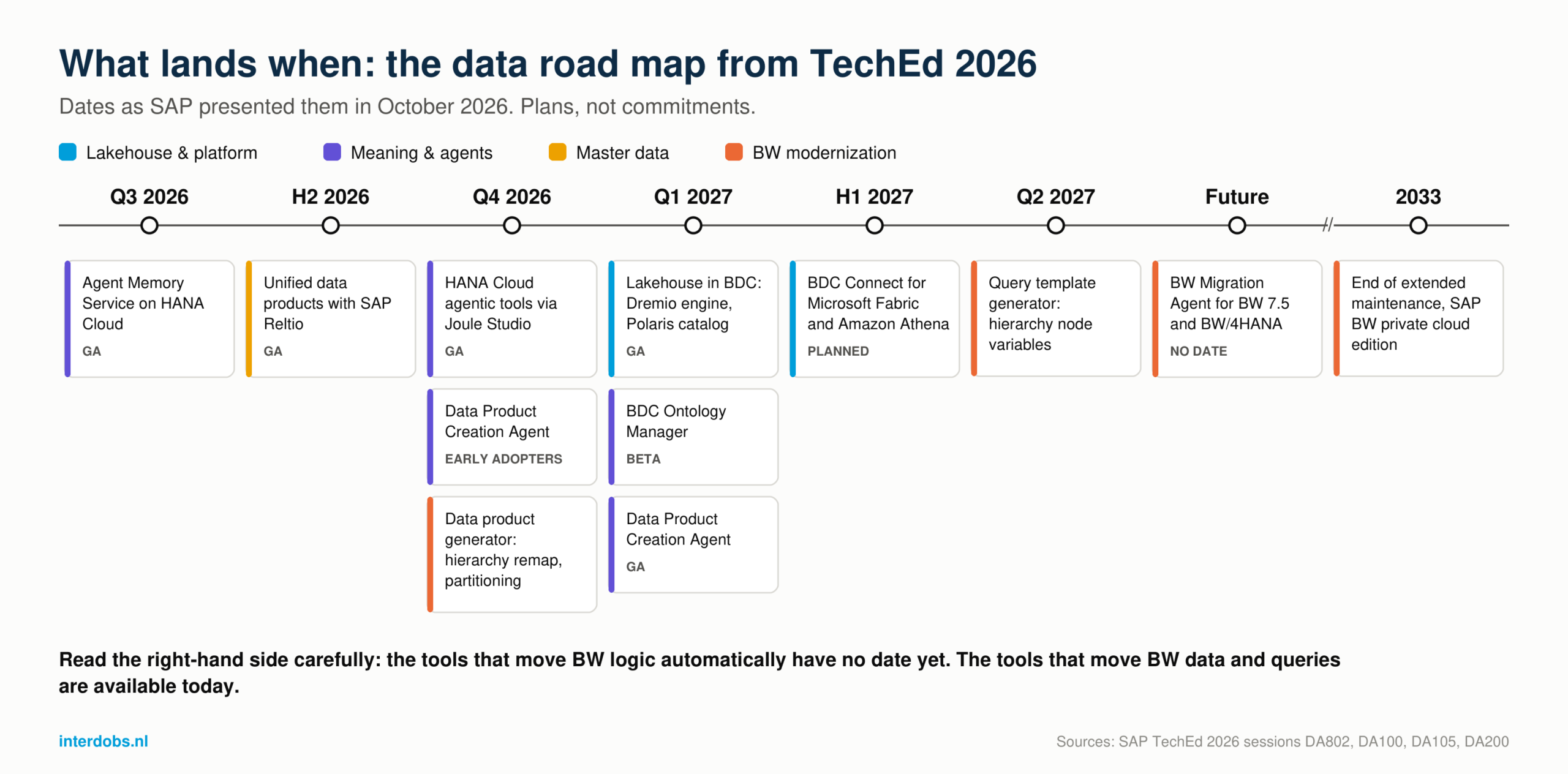
What lands when. Dates as SAP presented them in October 2026.
Datasphere. It is not going anywhere.It is becoming the modelling layer of Business Data Cloud, and it is gradually picking up the features BW people have been missing: hierarchy node variables, text variables, multi-fact models and linked hierarchy nodes are all on the Datasphere road map (DA200). The BW migration tools land in Datasphere too. What the week did not clarify is where HANA Cloud ends and Dremio begins. SAP calls both “intelligent compute”. Customers will need a rule of thumb, and SAP hasn’t given one yet. The architecture still needs to be drawn out fully.
Cost. No deck put a price on the new Business Data Cloud capabilities: not on Dremio, not on Reltio, not on the Ontology Manager. We know all will be part of BDC, paid with capacity units. What we did get were SAP claims (“up to 366% ROI” for unified master data, a “95% reduction in time to insight” with Dremio) and, where SAP did show prices, plain consumption billing. The Joule Studio runtime is priced per unit: €0.0128 per compute hour, €0.0092 per GB-hour of agent memory, €0.019 to €0.13 per workflow transaction, plus AI tokens (XP108). Running custom agents stays free until the end of 2026 (ST125). One line in the Dremio session (ST200) deserves more attention than it got: agent-driven query patterns “don’t follow a schedule”. A nightly batch has a predictable bill. A hundred agents asking questions whenever they like do not. Querying in place moves cost from pipelines to queries. Budget for it, and make someone responsible for FinOps. SAP ran a whole session on it (XP107).
What this means if you live in BW
Good news, mostly. The plumbing gets lighter, and fewer nights go to failed loads. But the skill that made a good BW consultant was never the extractor. It was knowing what the data in 2LIS_11_VAITM actually tells you about your business. How much will be translated into SAP standard data products and how much will be build by use (customer data products) remains to be seen.
Look closely and BW people have been building ontologies for twenty years. They just called them InfoObjects: attributes, hierarchies, compounding, navigation. That knowledge is exactly what SAP now needs in its graph.
The tooling to get it out is half there. The data product generator has been available since Q2 2025. It exposes InfoProviders, including associations, hierarchies and delta, as data products in Business Data Cloud. The query template generator, available since Q2 2026, turns a BW query into a Datasphere analytic model. More upgrades follow in Q4 2026 and Q2 2027. What isn’t there yet is the part everyone wants. The BW Migration Agent, which would translate data flows and rewrite ABAP routines in Python, is listed as a “future release” for both BW 7.5 and BW/4HANA.
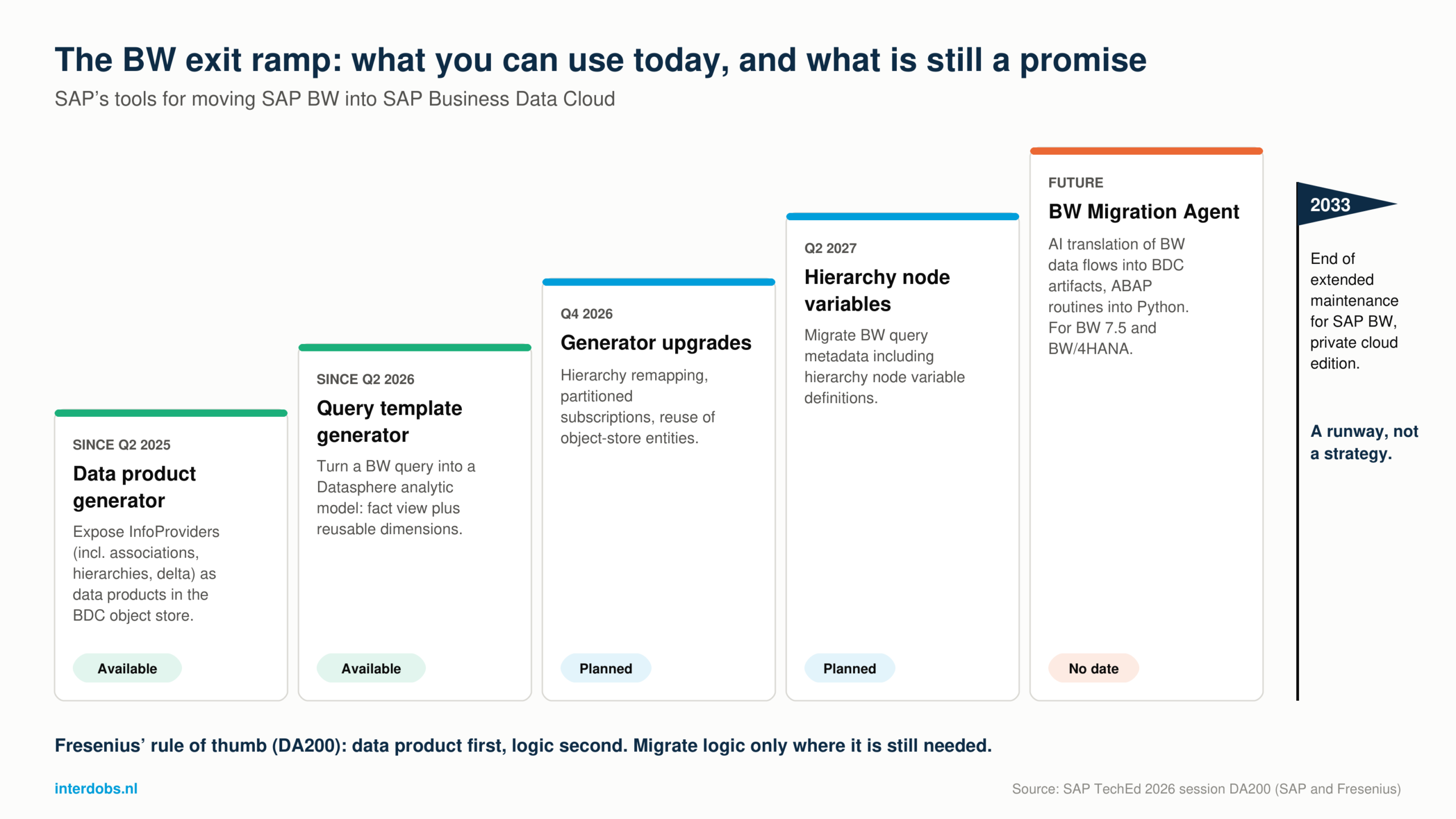
The BW exit ramp. Data and queries can move today; the automated translation of logic is still a promise.
Fresenius showed a sensible way through (DA200): a hybrid path, data product first and logic second, migrating logic only where it is still needed. The new platform builds on more than 200 SAP-managed data products covering 1,700+ source tables, and switching off BW is part of the plan. For anyone tempted to wait: SAP BW, private cloud edition, has extended maintenance until 2033. That is a runway, not a strategy.
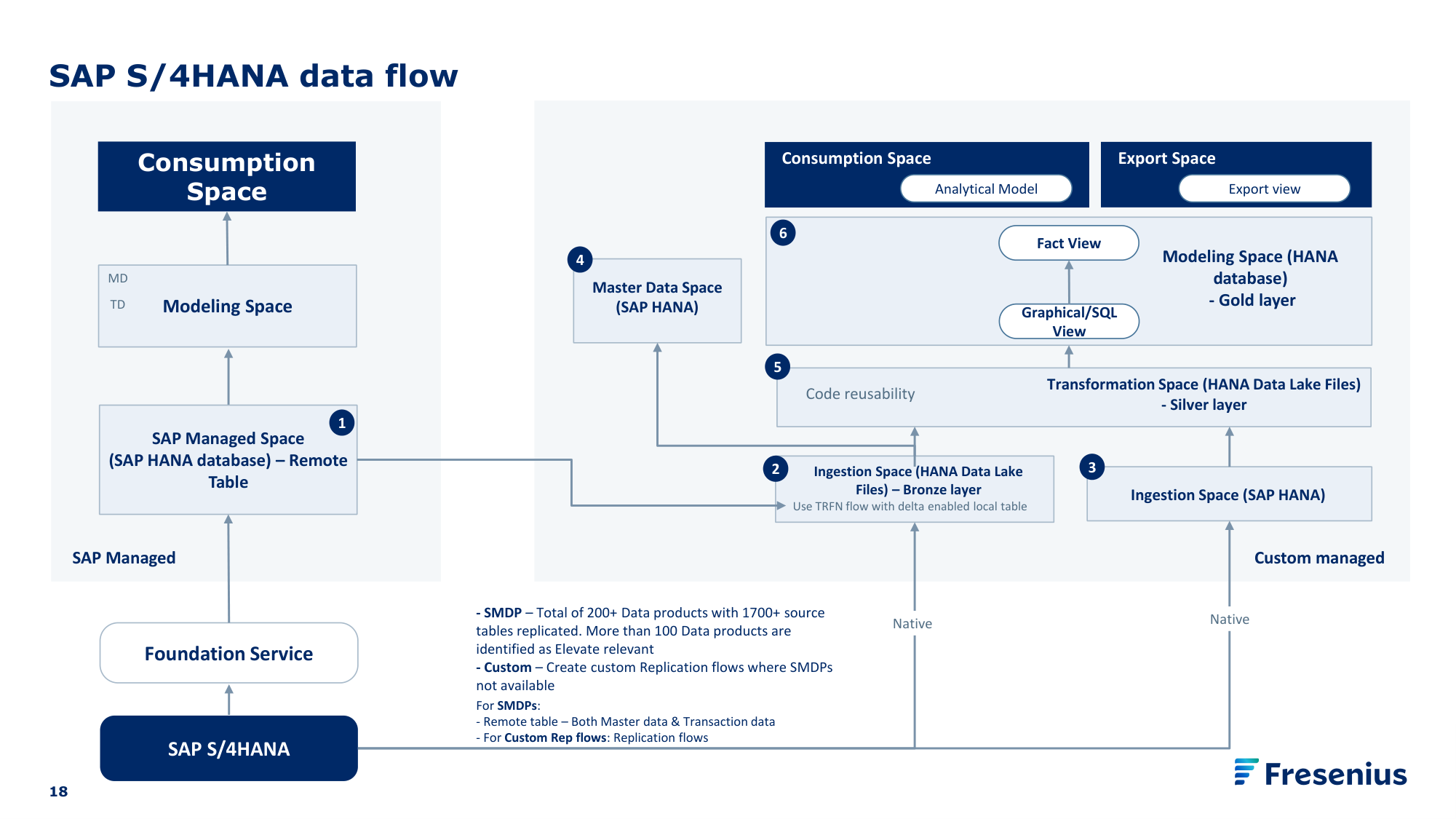
What it looks like in practice: Fresenius’ data flow from SAP-managed data products through bronze, silver and gold layers in Business Data Cloud. Slide: Fresenius, session DA200.
The missing migration agent is also the gap we built WavePath for. It reads BW metadata, plans migration waves and generates the target code for Datasphere and Business Data Cloud.
In a world where data stays put, the people who can describe it, model it and explain it to an agent become the scarce ones. That knowledge just moved up the stack.
Agents everywhere, governance not yet
Data was the quiet story. Agents were the loud one, and the numbers are striking. SAP AI Agent Hub has already discovered more than 650,000 AI agents in customer landscapes (BT116). In an SAP LeanIX survey, 98% of companies have deployed or plan to deploy AI agents, but only 17% can see what those agents actually do (ST127). SAP was also refreshingly honest about the technology. One session on agentic workflows worked from a roughly 25% error rate and an accuracy ceiling below 85% for AI steps, hence: “no blind autonomy” (ST137).
The session on SAP’s endorsed AI architectures (XP111) had the best one-liner of the week:
A guardrail you never watched reject a call is an assumption, not a control.
SAP TechEd 2026, session XP111
Its framework is worth copying: three layers, and you need all three. Can this identity reach the AI at all? Given access, how may it be used? And when the model decides to act, does the application agree? For data teams the link is direct. An agent is only as trustworthy as the data product it reads, and the access policy that comes with it. Remember the ZEISS pipeline monitor? In an agentic world, data observability stops being a nice-to-have.
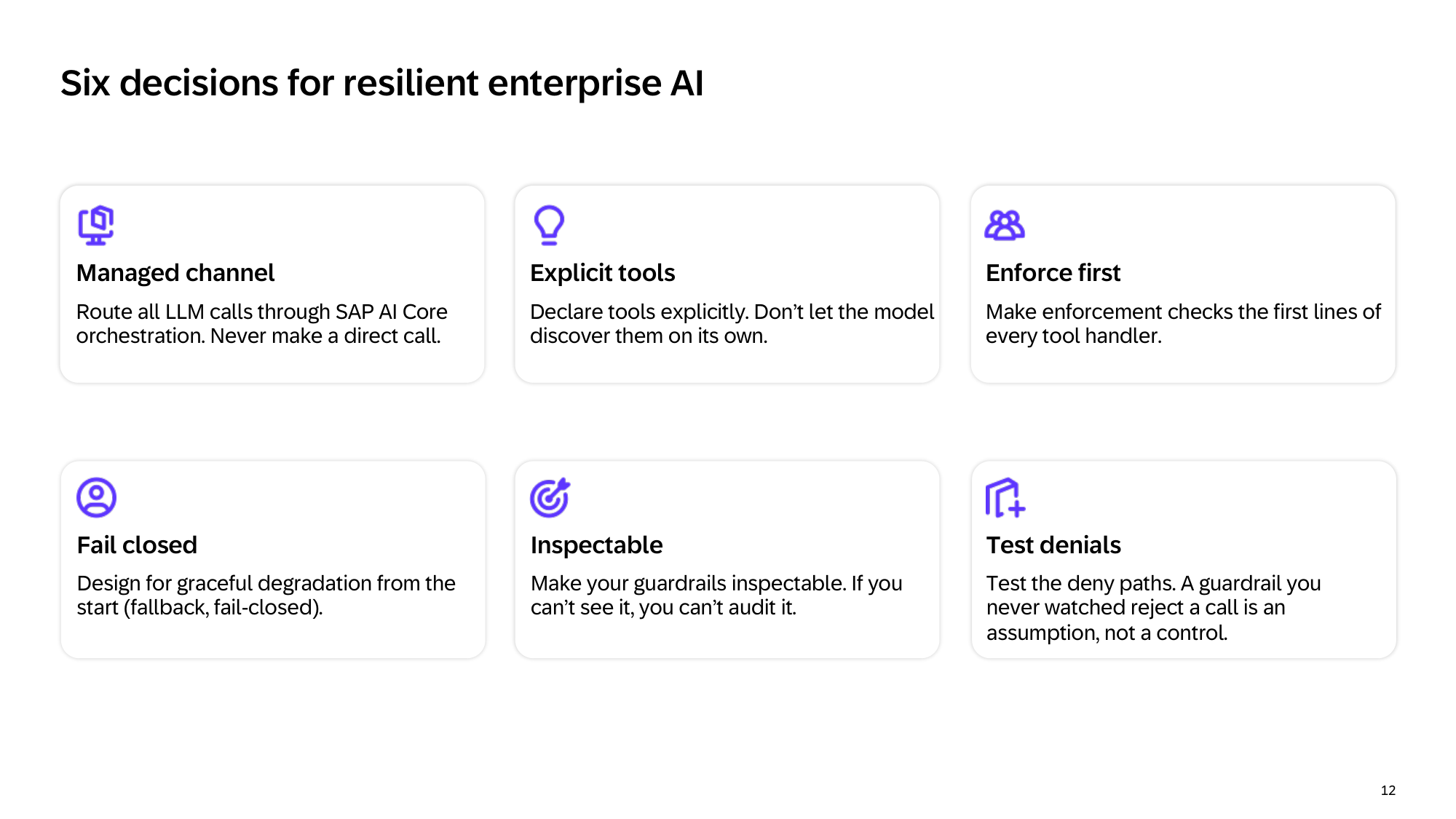
Six rules worth printing for every agent project. Slide: SAP, session XP111.
From story to strategy
So what do you actually do next week? Here is how we would turn TechEd into a plan, sequenced to SAP’s road map rather than its keynote. One rule runs through all of it: don’t let SAP’s tooling calendar set the pace of your BW exit.
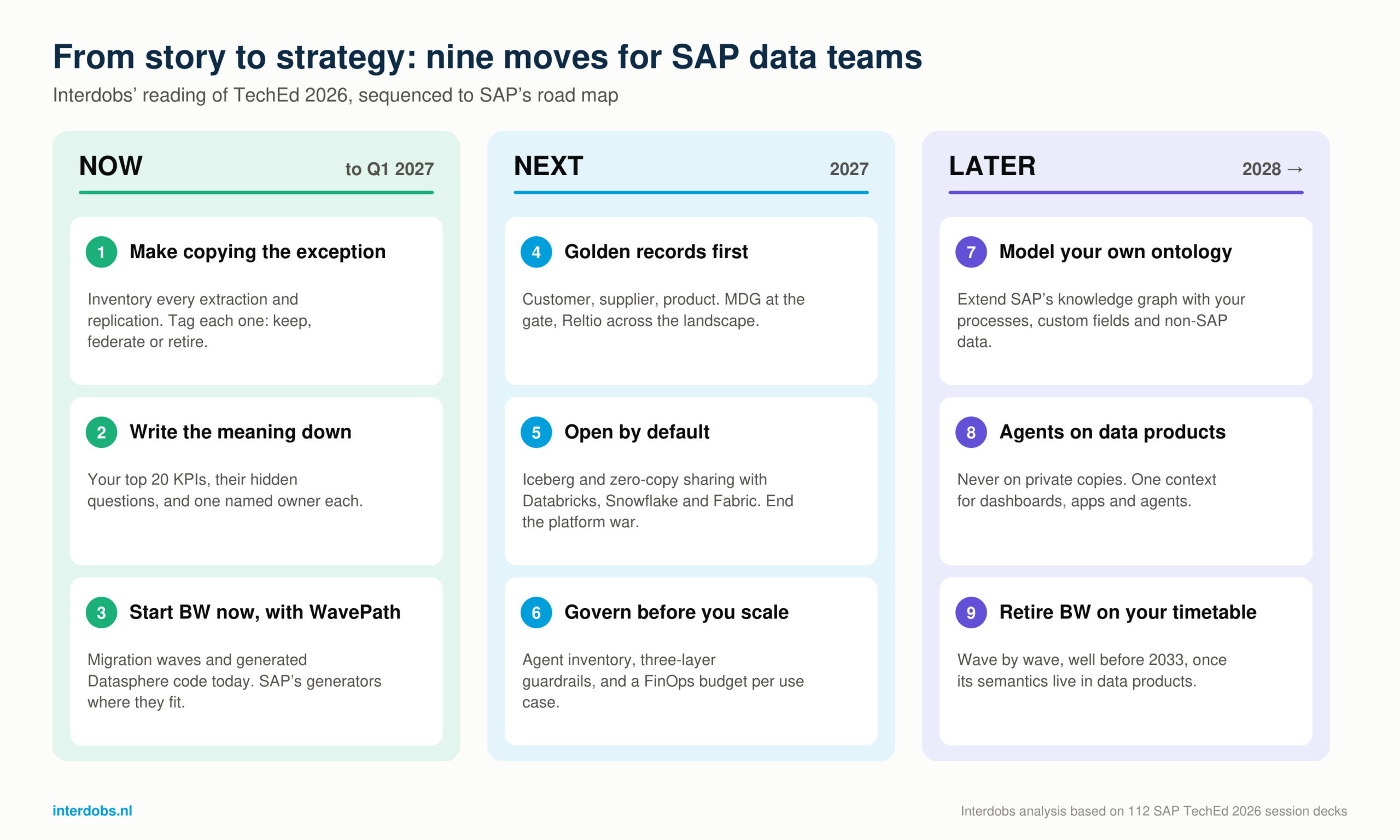
Nine moves, in three waves.
Now (to Q1 2027): start moving, don’t wait
- Make copying the exception. Inventory every extraction and replication flow and tag each one: keep, federate or retire. From now on, every new copy needs a reason.
- Write the meaning down. Take your twenty most important KPIs and write out their hidden questions: which date, which amount, which population, who may see it. Give each one a named owner. It is the cheapest AI investment you will make this year, and it pays off even if you never buy another licence.
- Start the BW migration now, with WavePath. SAP’s generators move BW data and query definitions, but the logic in between is where migrations stall, and SAP’s Migration Agent has no date. WavePath closes that gap today. It reads your BW metadata, maps dependencies and actual usage, splits the landscape into migration waves and generates the Datasphere code. Whatever it can’t translate is flagged for a consultant to review, not silently skipped. Use SAP’s data product generator and query template generator where they fit; let WavePath plan and carry the rest.
Next (2027): build what agents need
- Golden records before agents. Customer, supplier, product. MDG at the gate, Reltio across the landscape. No agent should act on a duplicate vendor.
- Open by default. Iceberg tables and zero-copy sharing with Databricks, Snowflake or Fabric. The war between SAP and the lakehouse is over; both sides signed.
- Govern before you scale. An inventory of every agent, three-layer guardrails, and a FinOps budget per use case.
Later (2028 and beyond): turn meaning into an advantage
- Model your own ontology. SAP’s graph knows standard SAP. Only you know your custom fields, your non-SAP systems and why plant 1000 is different.
- Put agents on data products, never on private copies. Dashboards, apps and agents share one context.
- Retire BW on your own timetable, well before 2033. With the migration running in waves, switching BW off becomes a planned milestone instead of a hope.
Where you start depends on where you are
- On BW 7.5 on-premises: start with the footprint. Reduce and tier data, and run a WavePath analysis before you move anything: many BW systems carry objects nobody has queried in years, and there is no point migrating those. Private cloud edition buys time until 2033, but the clock is running.
- On BW/4HANA: you are closest to Business Data Cloud. Let WavePath map your landscape into waves and generate the first one, and pilot SAP’s query template generator on a handful of real queries alongside it. Hierarchy node variables only arrive in Q2 2027.
- Already on Datasphere: your models carry over. Shift your effort from building pipelines to building data products with proper semantics and access policies.
- Running Databricks or Snowflake next to SAP: stop replicating SAP tables into your lake. Zero-copy sharing through BDC Connect gives you the data with its meaning.
What we’re still sceptical about
A fair wrap-up needs a few caveats.
- Dates are plans. The lakehouse and the Ontology Manager are still months away, and the BW Migration Agent has no date at all.
- The names keep moving. SAP BTP now appears as SAP Business AI Platform. Agent building is moving from SAP Build into Joule Studio. SAP Build Work Zone customers are told to prepare for Joule Work. Data product studio goes to Joule Studio. That is a lot of renaming for one year, and every rename costs customers change management.
- Open at the bottom, SAP at the top. Iceberg and Polaris are genuinely open. The knowledge graph and the ontology are SAP’s. Lock-in doesn’t disappear; it moves up the stack, to meaning. That may well be a fair trade, but it should be a conscious one.
- The ecosystem moves faster. In a joint session with SAP, the German user group DSAG described “faster non-SAP innovation, more cautious SAP adoption”, with sovereignty high on the agenda and AI architecture as “a hybrid picture” (ST136). SAP’s story only works if it fits that hybrid reality. This week suggests SAP knows it.
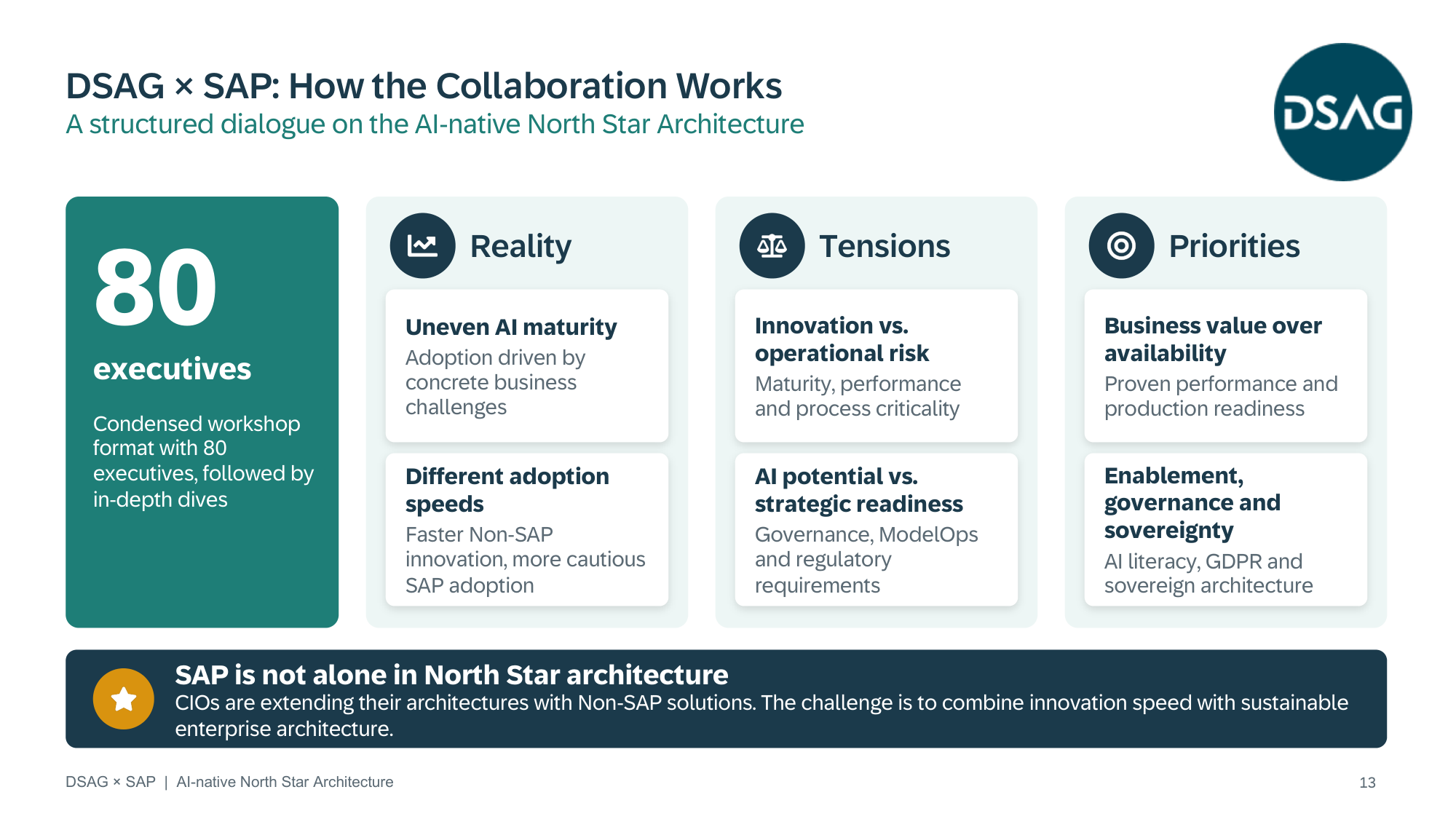
The user group’s reality check: uneven maturity, faster non-SAP innovation, sovereignty high on the list. Slide: DSAG and SAP, session ST136.
The bottom line
On Tuesday we wrote that SAP wants to stop moving your data around. After a week in Berlin we would put it more strongly. SAP is betting that the moat in enterprise AI is not the data itself but what the data means. Moving data becomes a commodity. Meaning becomes the product.
At Interdobs we do data. We have spent years moving SAP data around. On Tuesday we said we were looking forward to spending more time on what it means. After this week, that is no longer a preference. It’s the job.
Want to know what this means for your BW, Datasphere or SAP Analytics Cloud landscape? We are happy to think along, with your data rather than our slides. Get in touch or read more about SAP BW after 2027 and getting started with SAP Business Data Cloud.
This wrap-up is based on the slide decks of 112 SAP TechEd 2026 Berlin sessions. Session codes in brackets refer to the sessions quoted, including ST100, ST107, ST108, ST125, ST127, ST136, ST137, ST200, DA100, DA104, DA105, DA200, DA205, DA802, RA108, RA110, BT116, XP107, XP108 and XP111. Figures attributed to SAP are SAP’s own claims. Road map dates reflect SAP’s plans as presented in October 2026 and may change. Graphics: Interdobs. Slides: SAP SE and the presenting organisations (ZEISS, Fresenius, DSAG), from the TechEd 2026 session decks.
